


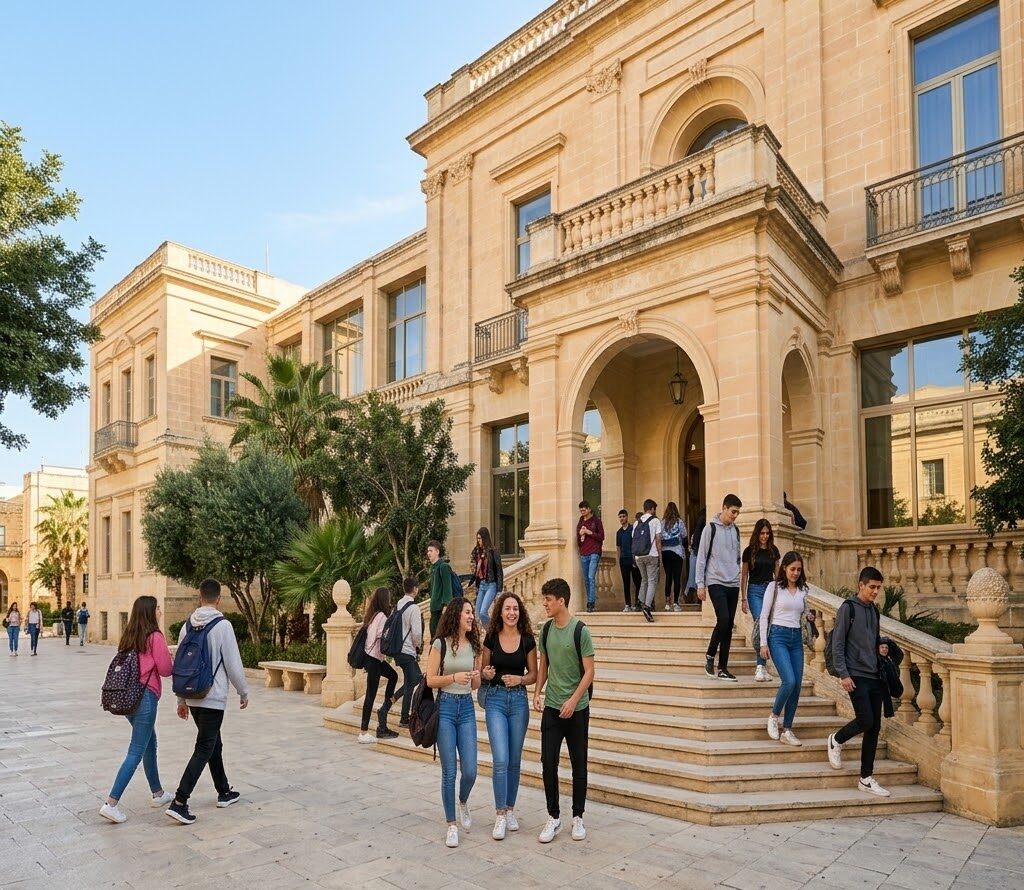
Moving from secondary school to post-secondary education is a major change for many students in Malta. Whether a student chooses sixth form or another form of further education, the transition usually comes with greater independence, more demanding subjects and a different approach to learning. For many students, it can feel like a big step, especially when they are used to the structure and routine of secondary school.
What Is Different About Sixth Form in Malta?
One of the biggest differences between secondary school and sixth form in Malta is the level of independence expected from students, especially in larger-scale institutions like Junior College. In secondary school, lessons tend to be more structured, and teachers often provide students with more guidance throughout their studies. However, in sixth form, students must start taking their own responsibility with note-taking and time management.
Lessons are also more focused on the specific subject, and go into more detail when compared to the same subject at Ordinary level. Instead of studying a broad range of compulsory subjects, students choose subjects that match their interests and future career plans. This means that the workload can become more demanding, and subjects are covered more in-depth.
Assignments and projects may require more research and independent work, while studying for examinations becomes increasingly important. Students also have to start becoming familiar with managing their own time, keeping up with notes and working on projects or assignments outside of lessons.
How Long Does Post-Secondary Education Take?
In Malta, post-secondary education at sixth form typically lasts for two academic years, starting in October through to May/June. During this time, students usually work towards their MATSEC (Matriculation and Secondary Education Certificate) examinations, including subjects taken at Advanced Level and others at Intermediate Level.
The MATSEC examinations take place in the May following the second year of studies at sixth form, with the possibility of sitting for a resit session the following September if one does not obtain the required grade. In general, students aim for a C or better in the subject, given that most university course admissions require the attainment of such a grade for course pre-requisite subjects.
Choosing Subjects at Post-Secondary Level
The subjects students choose to pursue are particularly important because they can determine which university courses they are able to apply for at a later stage. Different university courses have different subject requirements, so students need to think carefully about their choices rather than simply choosing subjects at random or because they seem interesting.
For example, someone planning to study a science or health-related course at university may need to take particular science subjects at Advanced Level, such as Biology, Physics and Chemistry. This is why understanding the Advanced and Intermediate subject requirements for a future university course can be useful before making subject choices.
Students can also make use resources such as MATSEC past papers to become familiar with the style and difficulty of examination questions. These can be especially useful when preparing for MATSEC Advanced Levels.
Choosing subjects was one of the more important parts of my own experience with sixth form in Malta. Personally, I chose Maltese, English, German, Physics and Marketing. This gave me a mixture of subjects that were quite different from one another, which made the experience interesting but also challenging.
One thing I soon noticed was that subjects could require completely different approaches to studying. A subject like Physics involves understanding concepts and applying formulas, while languages require vocabulary, grammar and communication skills. Marketing, on the other hand, involves understanding theories and being able to apply them to different situations.
Because of these differences, there isn’t necessarily one perfect way to study every subject. Students have to figure out which methods work best for each one.
My Experience of the Transition
Personally, the biggest challenge I found when moving from secondary school to post-secondary education was adjusting to the level of difficulty across all of my subjects. The jump wasn’t necessarily difficult because of one particular subject; rather, it was the fact that almost every subject required a higher level of understanding and preparation.
There was also a greater expectation to keep up with the work independently. It became important to understand that simply attending lessons wasn’t always enough. Reviewing material, completing assignments and preparing for examinations outside of class were all part of the process.
At the same time, sixth form wasn’t just about studying. One of the things I enjoyed most was meeting new people. Moving into a new environment meant being around students from different schools and backgrounds, which made the experience feel like a fresh start.
I also enjoyed learning more advanced subjects. Although the increased difficulty could be challenging, it was satisfying to move beyond some of the more basic material covered in secondary school and explore subjects in greater depth.
Is Sixth Form in Malta difficult?
The transition to post secondary education can certainly be challenging, but the difficulty varies depending on the subjects chosen and the individual student’s adaptability. Advanced Level subjects are designed to go into considerably more depth, so students should expect to put in more effort than they did during secondary school.
However, being challenged isn’t necessarily a bad thing. The increased workload can help students develop skills that will be useful at university as well as later in one’s own personal life, such as independent learning, time management and critical thinking.
Students who are considering sixth form have a lot to look forward to. It is normal for the first few months to feel like a significant adjustment. Over time, students can become more comfortable with the expectations and develop study habits that work for them.
A Challenging yet Rewarding Period of Transition
One of the most important things to remember about sixth form in Malta is that it is not simply a continuation of secondary school. It is also preparation for the next stage of education.
Students should consider what they might want to study at university when selecting their subjects. While plans can change, choosing appropriate subjects can prevent admission issues later when applying for specific courses.
It is also worth researching sixth form requirements and university entry requirements before making decisions. Speaking to teachers, career advisers and other students can also provide useful perspectives.
Ultimately, post secondary education in Malta is a period of transition. Students have more freedom to choose what they want to study, but that freedom comes with greater responsibility. The workload and difficulty increase, but so do the opportunities to learn and meet new people.
Based on my own experience, the opportunity to meet new people and study more advanced subjects made the experience worthwhile. Sixth form may require more independence and effort than secondary school, but it can also be an exciting step towards a more independent way of studying and living.