



The Matriculation and Secondary Education Certificate (MATSEC) Board – the national body responsible for administering the standard qualifications and examinations for secondary and post-secondary students in Malta- has officially overhauled its assessment framework.
In a major transition away from the legacy grading system, MATSEC has shifted to a modernized, level-based structure for Ordinary Level subject grading. This update fundamentally changes how student achievements are evaluated, blending school-based progress during the scholastic year with students’ final examination score.
How the Assessment Structure Has Changed
Ordinary level subjects in Malta are essential for entry into Sixth-Form and certain post-secondary education courses. Core subjects like Maths, English, Maltese and a Science subject are generally required for acceptance, whereas passes in specific subjects are required for the student to study the specific subject at an Advanced level.
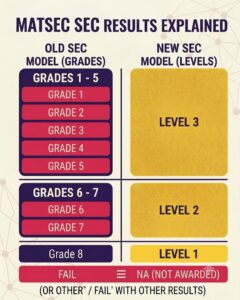
Under the former SEC assessment system (pre-2025), students were evaluated purely on traditional letter/number grades ranging from the topmost Grade 1 down to Unclassified (U). Grades 1 to 5 were considered successful passing grades, whereas levels 6-7 constitute a low-level passmark that most of the time does not grant entry to Sixth-form education.
The current SEC system shifts the focus entirely to holistic achievement levels. It combines a student’s continuous School-Based Assessment (SBA) mark with their final written examination score to award an overall qualification level.
The New Grading System Explained
According to data provided by MATSEC, the new structure directly corresponds to the legacy grades as follows:
Looking Ahead Towards a More Progressive Model
This transition marks a pivotal step toward a more progressive educational model in Malta, ensuring that a student’s hard work throughout the scholastic year is formally recognized.
By bridging the gap between daily schoolwork and final examinations, the current framework aims to reduce exam-related anxiety while providing a fairer, more comprehensive reflection of each student’s capabilities as they progress to post-secondary education.